Grease, Graft, and Glory: The Unsung Mechanics Holding British Motorsport Together
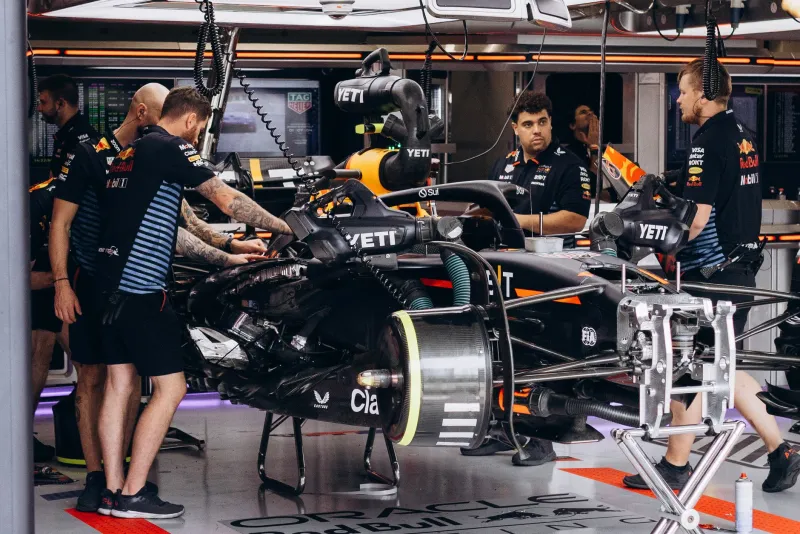
When Lewis Hamilton crossed the line to take his seventh world championship, the cameras followed him. When Max Verstappen clinched his fourth title, the world watched him cry in the cockpit. But somewhere in the blur of spraying champagne and team radio euphoria, there's a bloke in a fireproof suit — hands still trembling from a 2.3-second wheel change — who's already walked back to the garage to start stripping the car down.
No interview. No trophy. Just another job done.
British motorsport has a visibility problem, and it's not about the drivers. It's about the people who make the drivers possible.
The People Behind the Stopwatch
Ask any senior figure in UK motorsport who actually keeps a racing team competitive, and they'll give you a version of the same answer. "The driver gets you to Q3," one senior Formula 1 engineer told us, speaking on condition of anonymity. "But the crew gets you the win. Those are two completely different skill sets, and only one of them is on the poster."
Britain has long been the global epicentre of motorsport engineering. The so-called 'Motorsport Valley' — that cluster of expertise running through Oxfordshire, Northamptonshire, and beyond — employs tens of thousands of people. Aerodynamicists, composite technicians, data analysts, software engineers. But it's the mechanics, the ones with torque wrenches and sore knees, who arguably carry the most pressure in real time.
A pit stop in Formula 1 lasts less time than it takes to read this sentence aloud. Three seconds. Sometimes less. And every single person in that choreographed scramble has trained for months — sometimes years — to shave fractions off a process that's already borderline superhuman. Get it wrong, and a race is lost. Get it catastrophically wrong, and someone gets hurt.
From Milton Keynes to a Muddy Field in Lincolnshire
What makes the British mechanic story so compelling isn't just the F1 end of the spectrum — it's the full length of it.
Take Dave Hartley, a 54-year-old ex-army engineer who now runs the car preparation for a privateer team competing in the BRSCC's Fiesta Junior series. Every weekend, he's up at 5am, loading a knackered Transit with tools, spare parts, and enough determination to fill a paddock. He's not earning F1 wages. He's barely covering his fuel costs. But he's been doing it for 22 years because, in his words, "there's nothing else like it."
"People see the kid in the helmet getting the trophy," Dave told us over a brew at a recent Donington Park club meeting. "They don't see the three hours I spent the night before trying to source a gearbox mount because the one we had cracked in testing. I rang six people, drove forty miles, and had it fitted by midnight. That's grassroots motorsport."
Dave's story isn't unusual. Across Britain's sprawling club racing scene — from Croft to Pembrey, from Castle Combe to Snetterton — there are thousands of Daves. Skilled, experienced, passionate people who have accumulated knowledge that simply cannot be found in a textbook. They are the connective tissue of British motorsport culture, and most of them are completely invisible to the wider world.
Knowledge That Travels
One of the more fascinating aspects of the British mechanic ecosystem is how expertise moves up and down the motorsport ladder. Many of the engineers now working at the sharp end of Formula 1 started out exactly where Dave Hartley still operates — in the club racing paddock, learning by doing, making mistakes on a shoestring budget.
"You learn more in one season of club racing than you do in a year of theory," says former British Touring Car Championship crew chief Alison Mead, who started her career prepping a Clio Cup car in her dad's garage in Coventry. "You don't have the luxury of a spare part turning up in an hour. You figure it out. That problem-solving instinct — that's what separates a good mechanic from a great one."
Alison is now a respected figure in the BTCC paddock, but she's candid about the fact that her route in was anything but glamorous. "Nobody came looking for me. I turned up, worked hard, and made myself indispensable. That's how it works for most of us."
This transfer of knowledge — from grassroots to professional, from club racing to championship paddocks — is one of the quiet strengths of the British motorsport system. It creates mechanics who are adaptable, resourceful, and mentally tough. Qualities that no recruitment process can fully screen for.
The Recognition Gap
So why don't we talk about them more?
Part of it is structural. Motorsport's media economy is built around personalities — drivers, team principals, occasionally a flamboyant car owner. The mechanic doesn't fit neatly into a narrative arc. They don't have a Twitter following. They don't do press days. They're usually under an NDA anyway.
But there's also a cultural element at play. There's a long tradition in British working life of getting on with it quietly — of finding pride in the craft itself rather than seeking recognition for it. Many of the mechanics we spoke to for this piece were genuinely uncomfortable with the idea of being written about. "I just do my job," was a phrase we heard more than once.
That humility is admirable, but it comes at a cost. When the mechanics aren't visible, young people don't see a career path. When they don't see a career path, the pipeline starts to thin. Several team managers we spoke to flagged a growing concern about finding genuinely skilled mechanical talent — people who can work across multiple disciplines, think on their feet, and perform under pressure.
"We're not short of graduates," one team principal told us. "We're short of people who've actually turned a spanner under stress. That's a different thing entirely."
Giving Credit Where It's Due
Things are slowly changing. Social media has given some teams the space to spotlight their crew members — a behind-the-scenes Instagram reel here, a 'meet the mechanic' YouTube feature there. The FIA has made efforts to recognise pit crew excellence more formally. And at the grassroots level, organisations like Motorsport UK have begun making noise about the importance of technical volunteers and club-level engineers to the sport's survival.
But there's still a long way to go. The sport that Britain has built — the envy of the world, the foundation of multiple world championships, the training ground for generations of racing talent — rests on the shoulders of people who mostly just want to get back to the car.
Next time you watch a perfect pit stop, or see a privateer team pull off a points finish against the odds, spare a thought for the person who made it happen. Chances are, they're already back under the car — and they wouldn't have it any other way.