Grease, Graft, and Genius: Why the World's Race Teams Are Queuing Up for a British Mechanic
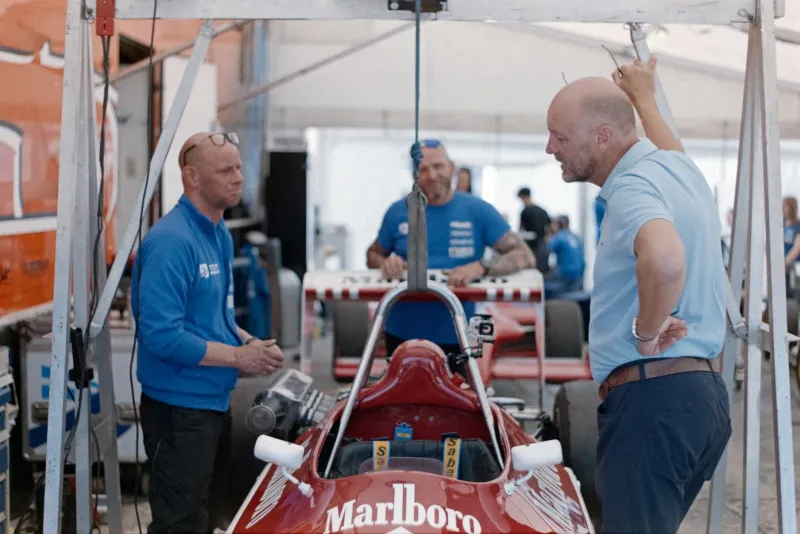
Danny has worked on racing cars for twenty-three years. He started sweeping floors at a Formula Ford team in Norfolk at seventeen, worked his way through Formula Three, a stint in the British GT Championship, and eventually landed a full-time role with a factory-backed squad competing across the European endurance calendar. He's never been out of work. He's never had to apply for a job. Every role he's ever taken has come from someone tapping him on the shoulder in a paddock.
"I've had calls from teams in Japan, America, Germany," he says, leaning against a toolbox in a Silverstone hospitality unit. "Word gets around. If you can fix things quickly and you don't panic under pressure, you become someone people want."
Danny is not unusual. Across the global motorsport industry, British race mechanics have developed a reputation that borders on mythology — sought after not just for their technical competence, but for a particular quality that's harder to define and impossible to manufacture: the ability to think clearly when everything is going wrong.
The Making of a British Mechanic
Understanding why British mechanics are so highly regarded starts with understanding how they're made. Unlike many European countries, where motorsport technical roles often feed through formal academic routes, the British pathway has historically been built on apprenticeships, club racing, and sheer accumulated mileage.
A typical journey might start in a family garage, move through a motorsport engineering course at somewhere like Motorsport UK's approved colleges, and then plunge headfirst into the deep end of club racing — where budgets are tight, hours are long, and the luxury of specialist support doesn't exist. You fix the gearbox yourself. You bleed the brakes yourself. You figure out why the car is pulling left at Clearways with forty minutes until qualifying, and you do it with whatever's in the truck.
"That's where it comes from," says Karen Whitfield, a senior technician who's worked in British Touring Cars and currently travels with a GT team on the Fanatec GT World Challenge Europe. "British club racing is brutal in the best way. You learn to improvise. You learn that panicking costs time and time costs positions. By the time you get to a properly funded team, you've already seen everything."
The culture of hands-on learning is reinforced by a network of workshops, race preparation companies, and small engineering firms clustered throughout Motorsport Valley that function as informal finishing schools. Young mechanics rotate through these outfits, absorbing knowledge from senior staff in a way that no classroom can replicate.
The Troubleshooter's Instinct
What makes British mechanics specifically valuable as troubleshooters — rather than just competent technicians — is a combination of experience breadth and a cultural disposition towards pragmatic problem-solving.
In a race environment, problems rarely announce themselves clearly. A vibration might be a wheel bearing, a driveshaft, a loose undertray, or a dozen other things. The mechanic who can narrow it down fastest — through instinct as much as diagnosis — is worth their weight in titanium. And British mechanics, forged in the resource-scarce environment of domestic club and championship racing, tend to develop that instinct earlier and sharper than their counterparts raised in better-funded programmes.
"I've worked with mechanics from France, Germany, Italy — all excellent," says one race engineer who's been in the paddock for over fifteen years. "But there's something about the British ones. They're not precious about the work. They'll lie under a car in the rain at midnight without being asked. And when something weird happens, they don't wait for instructions — they start investigating. That self-starting quality is genuinely rare."
Several team managers in the World Endurance Championship and GT World Challenge paddocks echo this sentiment. One German squad, competing at the top level of European GT racing, has actively recruited British mechanics for the past six seasons, describing them as a "cultural asset" within a team that prides itself on adaptability.
The Export Premium
The commercial reality of British mechanical talent is that it commands a premium — and the premium is growing. Experienced British race mechanics working at the top of the European endurance or GT pyramid can earn significantly more than their domestic equivalents, particularly when overseas teams factor in relocation packages, per diems, and the kind of retention bonuses that have become common in a competitive hiring market.
For teams, it's a straightforward calculation. A mechanic who can solve an unexpected problem in the pits during a race — potentially saving a result worth hundreds of thousands in prize money and manufacturer bonuses — is not a cost. They're an investment.
"Teams will pay for certainty," says one motorsport recruitment consultant who places technical staff across European and North American series. "And British mechanics have built a reputation for delivering it. The demand has genuinely accelerated in the last five years. We struggle to fill all the enquiries we get."
The Challenges Ahead
For all the flattering reputation, the British race mechanic pipeline faces genuine pressures. The cost of living, particularly in the areas closest to Motorsport Valley, has made entry-level roles financially challenging for young people who aren't supported by family. The irregular hours and extensive travel — romantic from the outside, grinding from within — contribute to a dropout rate that concerns team managers who've invested in developing talent.
There's also the question of whether the traditional apprenticeship model can survive in an industry increasingly drawn towards formal qualifications and structured graduate programmes. Some veteran mechanics worry that the informal, experience-first pathway that produced their generation is being gradually formalised out of existence.
"The best mechanics I've ever worked with never went to university," says one Formula 1 garage veteran, now working in a senior role at a British GT outfit. "They went racing. There's a difference."
The world, for now, still agrees. And until that changes, the phone will keep ringing for Danny and the thousands like him — British mechanics who learned their trade the hard way, and are worth every penny because of it.