When the Pitwall Goes Digital: Can AI Ever Replace the Human Brain in Race Engineering?
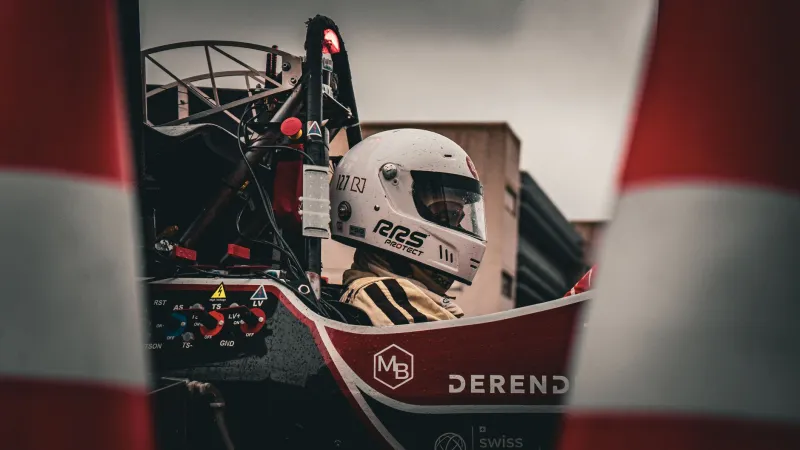
There's a moment in every race — you'll know it if you've watched enough of them — where everything goes sideways. A safety car that nobody predicted. A sudden downpour on a bone-dry circuit. A rival team making a call that defies all logic and somehow works brilliantly. In those moments, the person on the pitwall earns their salary. Or at least, they used to.
Because increasingly, that person has a very powerful assistant sitting beside them. One that doesn't drink coffee, doesn't argue, and can process a season's worth of telemetry data in roughly the time it takes you to blink. Artificial intelligence has arrived in race engineering, and it's not knocking politely at the door — it's already inside, rearranging the furniture.
The Algorithm Joins the Team
At the top levels of motorsport, AI-assisted engineering tools have become part of the furniture. Formula 1 teams have been quietly integrating machine learning into their data analysis pipelines for years, using it to model tyre degradation curves, optimise pit stop windows, and flag anomalies in power unit behaviour before they become catastrophic failures. McLaren, Mercedes, and Red Bull have all spoken openly — to varying degrees — about their investment in data science infrastructure. What they're less forthcoming about is exactly how much of the strategic decision-making is now being shaped by the machine rather than the man.
"The tools are extraordinary," admits one senior engineer who works with a British-based GT outfit and asked not to be named. "You're getting real-time recommendations during the race that account for variables I wouldn't have time to compute manually. Fuel load, projected lap delta, competitor strategy likelihood — it's all there. The question is whether you trust it when it contradicts your own read of the race."
That tension — trust versus instinct — is precisely where the debate gets interesting.
The Intuition Problem
Talk to any engineer who has spent serious time at a circuit and they'll tell you about the feeling. Not data, not a readout — a feeling. The way a driver's voice changes over the radio when something isn't right. The subtle shift in lap times that doesn't show up as a spike on the graph but tells an experienced eye that the car is about to have a problem. The hunch, born from years of experience, that says box this lap when every data point says stay out.
Dave Robson, Williams' head of vehicle performance, touched on this in a 2023 interview when he described race engineering as a blend of science and artistry. It's a sentiment echoed across the paddock. The science, everyone agrees, is increasingly AI territory. The artistry is where things get murky.
"A model is only as good as the data it's trained on," explains Dr. Sarah Okafor, a motorsport data scientist who has consulted for several British touring car outfits. "If something genuinely unprecedented happens — a scenario the system has never seen — it either defaults to a nearest approximation or it flags uncertainty. A human engineer with twenty years in the sport might recognise something analogous from a race in 2009. That contextual memory is really hard to replicate artificially."
This is the uncanny valley of AI engineering. The systems are impressive enough to be genuinely useful, but not quite complete enough to operate without a human safety net. And in that gap lives a whole lot of professional anxiety.
Grassroots Doesn't Get Off Lightly Either
It would be easy to assume this is purely a top-tier problem — something for F1 engineers to worry about while the rest of us get on with bleeding brakes and arguing about tyre pressures in a cold Donington Park paddock. But the technology is filtering down faster than most people realise.
Affordable telemetry platforms now come bundled with basic AI analysis features. Club-level teams in the British Touring Car Championship support series are experimenting with predictive tools that would have seemed science fiction a decade ago. Even some well-funded amateur outfits in the Britcar Endurance Championship have started using machine learning models to assist with stint planning.
For the weekend warriors who live for the human drama of club motorsport — the mechanic who diagnoses a misfire by sound alone, the engineer who reads a driver's body language at the debrief — this feels like an encroachment on sacred ground.
"Part of what makes our sport special is that it's people solving problems under pressure," says Kevin Marsh, a club racing competitor and amateur mechanic who has been campaigning a Caterham in various championships for over a decade. "If you take that problem-solving away and hand it to a box, what's left? You're just operating the machine, not engineering it."
The Case for the Machines
To be fair to the algorithms, there's a compelling counter-argument. Human engineers make mistakes. They suffer from cognitive bias, fatigue, and the kind of emotional investment in a driver or a car that can cloud judgement at critical moments. An AI doesn't panic when the championship lead is on the line. It doesn't second-guess a statistically optimal call because the team principal is breathing down its neck.
In endurance racing especially — where strategic decisions compound over six, twelve, or twenty-four hours — the ability to maintain consistent, unbiased analysis is genuinely valuable. Several LMP teams competing in European endurance series have reported measurable improvements in strategic efficiency since integrating AI-assisted planning tools.
The argument, then, isn't really AI versus human. It's about finding the right balance — using the machine to handle the computational heavy lifting while preserving the human element for the judgement calls that require something more than processing power.
Where Does This Leave the Engineers?
The honest answer is: in a complicated place. The engineers who adapt — who learn to work alongside these tools, understand their limitations, and know when to override them — will likely find their roles enhanced rather than diminished. The ones who resist entirely risk being left behind.
But there's a broader cultural question that motorsport, as a community, needs to sit with. The sport has always celebrated the mechanical genius, the grease-stained wizard who can feel what's wrong with a car before the data confirms it. If AI gradually absorbs the analytical dimension of that role, what remains? And does what remains still feel like motorsport?
For now, the pitwall still has humans on it. They're just sharing the bench with something that never sleeps, never doubts itself, and gets a little bit smarter every single race. Whether that's progress or something more unsettling probably depends on which side of the garage you're standing on.