Spanners, Sweat, and Speed: The Hidden Workshops Powering British Motorsport
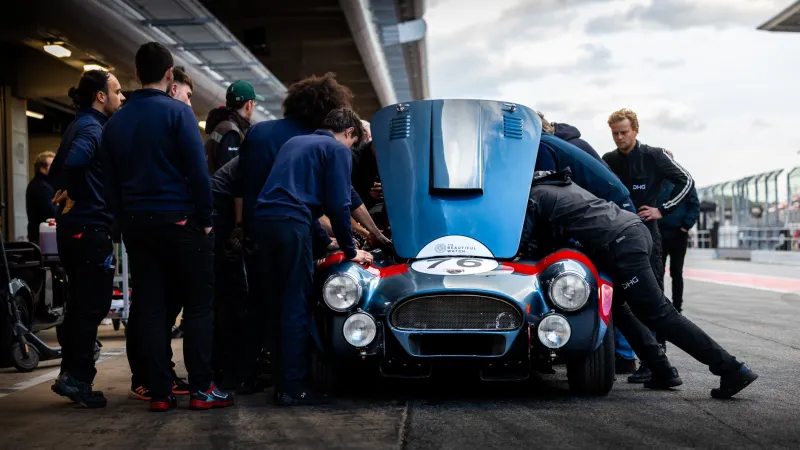
Pull off the A43 near Brackley on any given Tuesday morning and you'll hear it before you see it — the shriek of a lathe, the hiss of a welder, the rhythmic percussion of a press fitting a suspension wishbone. Step through the roller door and you're in another world entirely. Fluorescent strips flicker over tool chests worn smooth by decades of use. A hand-scrawled parts list is taped to a whiteboard next to a photo of a car crossing the line in first place somewhere muddy and glorious.
This is where British motorsport actually lives.
For all the glamour of Silverstone grandstands and the slick corporate polish of Formula 1 hospitality suites, the real engine of UK racing culture runs on strong tea, stubborn problem-solving, and a refusal to accept that something can't be done. Scattered across the country — from industrial estates in Banbury to converted farm buildings in Norfolk — are hundreds of small independent workshops that quietly, consistently punch so far above their weight it borders on the absurd.
The Art of the Bespoke Build
Take suspension. It sounds unglamorous, but ask any serious racing driver what separates a car that wins from one that merely competes and they'll tell you the same thing — it's all in the geometry. Firms like Nitron, Gaz Shocks, and a handful of smaller one-and-two-person operations dotted around the Midlands have built international reputations by doing one thing exceptionally well. They build dampers and corner weights that are dialled in not just to a spec sheet, but to a specific driver on a specific circuit.
"We had a customer come to us who'd been struggling at Snetterton all season," says one engineer who asked not to be named, running a small fabrication outfit near Daventry. "Spent two hours on the phone with him going through his data logs, then rebuilt his front end from scratch. He won the next round. That's what we do — we solve the puzzle."
This is the kind of institutional knowledge that doesn't appear in any brochure. It's accumulated through years of trackside problem-solving, of watching how a car moves through Maggotts at 150mph and understanding instinctively what the data is trying to tell you.
Electronics, the New Black Art
If suspension is the craft of the hands, electronics is the craft of the mind — and Britain has quietly become a world leader in motorsport electronics engineering. Much of this traces back to the gravitational pull of Formula 1 and its supply chain, which has seeded talent across the country for decades.
Companies like Cosworth, Pi Research, and MoTeC's UK distribution network have trained generations of engineers who've gone on to set up their own operations. The result is an ecosystem where even a club-level competitor running a modified Clio can access data logging, traction control calibration, and ECU mapping that would have seemed science fiction to a touring car team twenty years ago.
"The knowledge base in this country is extraordinary," says a motorsport electronics consultant who works across multiple racing disciplines from his workshop in Northamptonshire. "I can have a conversation with a guy building a hillclimb special in his garage and he'll understand concepts that most engineers in other countries would struggle with. That's not arrogance — it's just the environment we've grown up in."
Fabrication: Where Imagination Meets Steel
Walk into a top-end British fabrication shop and you'll find TIG welders producing roll cage sections so clean they look machined rather than hand-welded. Titanium brackets. Carbon fibre body panels. Bespoke exhaust manifolds sculpted to extract every last horsepower from an engine that was never designed to go racing.
The fabrication community is tightly knit and fiercely proud. Many of the craftspeople working in these shops learned their trade through apprenticeships that barely exist anymore — through motorsport colleges like Oxford Brookes or Buckinghamshire New University, or simply by turning up at a local race team and making themselves useful. The knowledge transfers informally, person to person, in a way that no university curriculum can fully replicate.
What's remarkable is how this expertise flows upward. It's not unusual for a small shop building customer race cars to supply components — or even entire sub-assemblies — to professional outfits operating at national or international level. The line between amateur and professional is blurrier in British motorsport than almost anywhere else in the world.
Why Britain Does It Better
So what's the secret? Why does this small island produce such a disproportionate concentration of motorsport engineering talent?
Part of the answer is geography and history. The clustering of Formula 1 teams along the so-called Motorsport Valley corridor — roughly following the M1 and M40 through Oxfordshire and Northamptonshire — has created a talent pool that spills over into every adjacent discipline. Engineers move between teams, between series, between the elite and the grassroots. Ideas travel fast.
But there's something else, something harder to quantify. British motorsport culture has always celebrated the builder as much as the driver. The kit car tradition, the hillclimb specials, the club racing scene — these are all environments that reward ingenuity and resourcefulness over raw budget. When you can't afford to buy the solution, you build it. And over generations, that necessity has bred a culture of genuine, deep-rooted engineering creativity.
The Threat on the Horizon
None of this is guaranteed to last. Skills shortages, rising materials costs, and the relentless consolidation of motorsport supply chains all pose real threats to the independent workshop ecosystem. Several veteran engineers spoken to for this piece expressed concern about the next generation of skilled fabricators and mechanics — not because young people aren't interested, but because the routes into the trade are increasingly narrow and expensive.
"We need apprentices," says one workshop owner bluntly. "Not graduates. Apprentices. People who want to learn with their hands. We've got more work than we can handle and not enough people to do it."
It's a problem the industry needs to take seriously — because the workshops described in this article aren't peripheral to British motorsport success. They are British motorsport success. They're the reason our drivers arrive at circuits around the world with cars that are better prepared, more cleverly engineered, and more thoroughly understood than almost anyone else's.
The trophies might sit in the driver's cabinet. But they were built, bolt by bolt, in workshops that most people will never see.