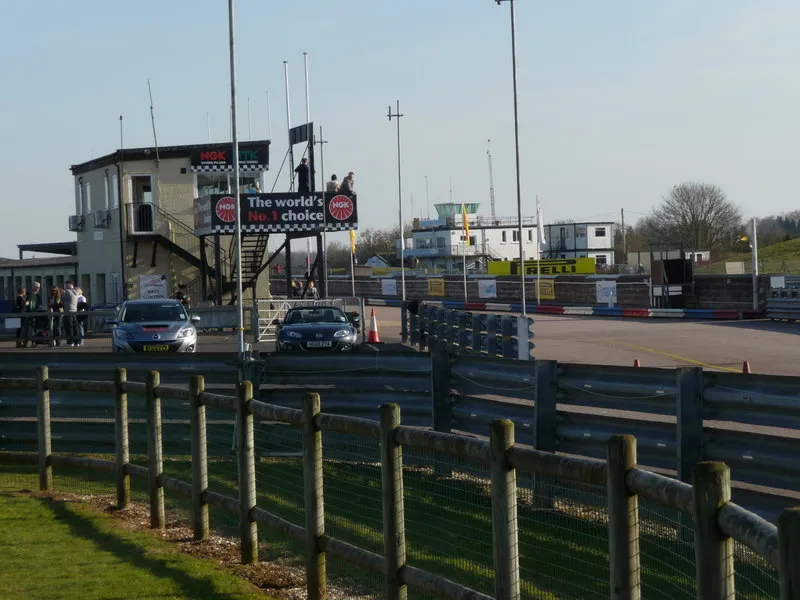
Photo: Chris Talbot , CC BY-SA 2.0, via Wikimedia Commons
Stand at the fence at any club meeting in Britain and you'll hear the same thing: an engine, a crowd, and a steward shouting into a radio. It's the sound of a small local economy and a very large community doing something it loves. It's also, depending on where the wind is blowing, the sound that lands in somebody's kitchen a mile away and ruins their Sunday afternoon.
Both of those things are true. That's the whole problem, and it's why Britain's circuits have been fighting the same battle for decades.
The complaint that never goes away
Every circuit in the country has a story. A neighbour who keeps a log. A parish council that has passed a resolution. A resident who bought a house near a track and then discovered, with genuine surprise, that the track is quite loud. Sometimes it's a single determined individual. Sometimes it's an organised association. Either way, the mechanism is the same: complaints in, pressure on, and an operator counting race days.
Britain has a few dozen permanent circuits and almost all of them have found themselves in a noise dispute at some point in their history. That's not a scandal. It's a structural feature of racing in a crowded island.
A statutory nuisance is a blunt instrument
Here's the piece of law that should worry every motorsport fan in the UK. Under the Environmental Protection Act 1990, a local authority can serve a noise abatement notice if it considers something is causing a statutory nuisance. That power doesn't require the operator to be breaking their planning permission. A circuit can be doing precisely what it was given permission to do and still find itself on the wrong end of a notice.
The consequences aren't abstract. Mallory Park found out the hard way more than a decade ago, when a notice was served and racing on the Leicestershire oval was suspended while the matter was fought through the system. It was eventually resolved, but the episode sent a shudder through the sport. Because the message was unmistakable: lawful doesn't automatically mean safe.
If you're the volunteer club treasurer trying to plan a season, that's the nightmare. It isn't just losing a meeting — it's the legal bill, the uncertainty, and the sponsors and spectators who won't bother coming back next year.
Houses first, then the track
Planning pressure is the other half of the story. Circuits that were once in the middle of nowhere now find themselves on the edge of a development boundary. Build the houses, move the people in, wait for the first warm weekend.
In theory, planning policy has an answer: the agent of change principle, written into national policy, which says that a new development near an existing noise source should have to deal with the noise it's moving towards, not the other way round. It's the right principle, and when it's applied properly it works. The problem is that it's applied inconsistently. Local plans come with conditions — race day limits, curfews, restrictions on quiet weekends — that can strangle a venue's income without ever appearing to close it.
And a planning condition is a slow kill. Nobody wins an argument about it on the news. The circuit simply finds it can't run enough days to be viable, the track days and experience days fill the gap, and the racing quietly gets squeezed to the margins.
Noise isn't waste — it's the product
Here's the philosophical point that too often gets lost. A factory is expected to muffle itself. A concert venue is expected to be reasonable. But for a circuit, the noise is not an unfortunate by-product of a business that would happily be silent. It is the thing itself. Silence a racetrack and you haven't made a better neighbour — you've closed a racetrack.
That doesn't give circuits a free pass. Most of them already do the work: static and drive-by sound limits, silenced exhausts, mandated noise meters, community liaison groups, open days, free tickets, deliberately quiet weekends, and a genuine effort to be a good neighbour. The operators know that a complaint file is a slow-acting threat.
But being reasonable shouldn't mean being a doormat. Compromise only works if both sides accept the other has a legitimate existence.
The electric argument won't save us
The optimistic line is that electrification will solve all of this. It won't, at least not in the timescale people imagine. Yes, an electric racing car is quieter at low speed, but tyre and wind noise at racing pace is substantial. Meanwhile the club racing backbone of this country runs on 1990s and 2000s hatchbacks that its competitors can just about afford to keep running. Converting them is fantasy. And nobody is going to electrify a historic Formula Ford and claim it's the same car.
Even if the technology were free, something else would be lost. The sound is part of the spectacle. Take it away and you have a very expensive procession — efficient, quiet, and culturally invisible.
What survival actually looks like
So what's the answer? Partly it's legal and political: consistent application of the agent of change principle, a clearer national framework recognising established motorsport venues as assets worth protecting, and a planning system that treats a circuit as infrastructure rather than as a temporary use of land waiting for its real value.
Partly it's commercial. Circuits have to diversify — track days, testing, manufacturer work, driving experiences, cycling, conferences, even the odd concert. That's not a betrayal of the sport, it's the only way the gates stay open. But every new revenue stream brings its own noise, traffic and planning conditions, and none of them replace a full race calendar.
And partly it's cultural. The wider public needs to hear the argument that the sound of a racing circuit is like the sound of church bells or the shipping forecast — a thing some people find irritating and others find irreplaceable, and which a country that cares about its own character makes room for.
The uncomfortable bit for everyone
We should be fair to the people who complain. Living next to a circuit is genuinely loud. Some of them have been there longer than the current owners. Some have tried every reasonable channel and been met with shrugs. Circuits need to keep earning their licence to operate, and dismissal of every concern does the sport no favours.
But here's the hard truth to finish on. Land is worth more as houses than as a racetrack. Every circuit in Britain sits on a plot that a developer would happily take off the table. Once one closes, it never comes back. Not in five years, not with a new owner, not ever. Planning permission doesn't get un-sold, and the tarmac doesn't get relaid.
Which means this argument is not really about a Sunday's noise. It's about whether we get to keep the thing at all. If the roar is treated as a nuisance, we'll get silence — and silence, in the end, is permanent.