The Men and Women in Orange: Inside the Volunteer Army Holding British Motorsport Together
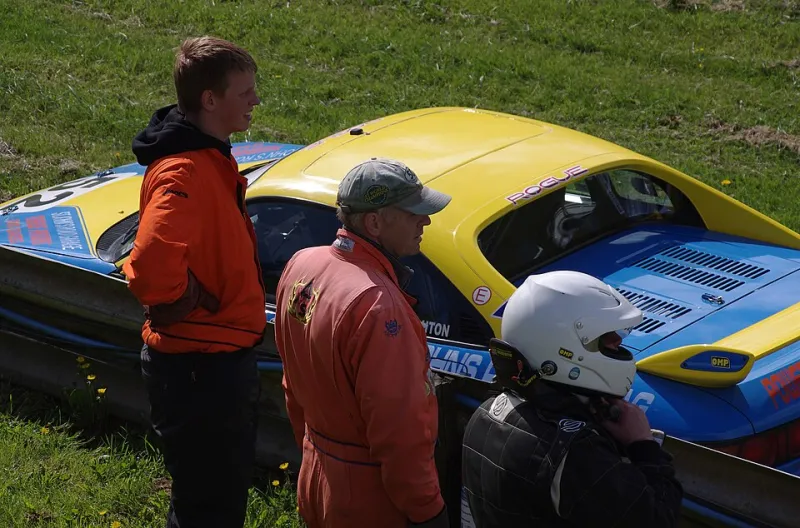
Photo: mattbuck (category), CC BY-SA 3.0, via Wikimedia Commons
It's 6:40 on a Sunday morning and the Lincolnshire hills are still holding on to the mist. Down in the paddock a kettle is doing its first shift of the day. Up on the bank, a line of orange bibs is already walking the tyre wall, checking that last night's wind hasn't shifted anything it shouldn't have.
Nobody is paying them. Most have driven two hours to be here. Some have driven four. By the time the first engine fires they'll have signed on, sat through a briefing, tested the radios and walked the circuit. By the time the last trailer rolls out of the gate they'll have swept the gravel, stacked the cones, and had a thoroughly unnecessary argument about whose job it was to lock the paddock gate.
British club motorsport runs on exactly this. Not on sponsorship, not on television money, not on the goodwill of a manufacturer — on a volunteer army of marshals, recovery crews, scrutineers, timekeepers and officials who hand over their weekends so that somebody else gets to race.
Meet the orange army
If you've only ever watched motorsport through a fence or a screen, the people in orange can blend into the scenery. They shouldn't. A typical club race meeting needs somewhere between forty and ninety officials, depending on the circuit, the grid sizes and how many posts the organisers can actually staff. Flag marshals. Incident officers. Post chiefs. Fire marshals. Rescue crews. Recovery riggers. Pit lane and assembly. Startline. Timekeepers. Scrutineers. Clerks of the course. A whole small town's worth of jobs, most of them filled by people who have never taken a penny for a day's work in their lives.
The grading ladder is a proper one, too. Trainee, track, experienced, post chief — each step earned through logged days, assessments and training rather than simply turning up often enough. Fire and rescue specialisms sit alongside. Recovery work is technical enough to be a trade in its own right, all rigging, lifting points and load angles.
The recruitment problem nobody wants to talk about
Here's the uncomfortable bit. The orange army is greying. Ask anyone who runs a post and you'll hear a version of the same story: a core of lifers who've been doing it for thirty years, a thinner middle, and not enough new faces coming through to replace them. The pandemic knocked a hole in the pipeline that still hasn't fully closed. Training days were cancelled, newcomers drifted away, and some never came back.
The reasons people give for not starting are rarely about the racing. It's the fuel to get there. It's weekend shifts in jobs that don't care about your hobby. It's the perception — stubbornly alive — that marshalling is a closed club for retired blokes with flasks. It isn't, but perception takes its time.
Clubs have got better at this. Taster days, social media recruitment, family-friendly camping, schemes that let a newcomer try a post without signing their life away for a season. The message is always the same: no experience needed, boots and a waterproof essential, and you'll be looked after.
Training days: fire, flags and a surprising amount of paperwork
What catches most newcomers out is the volume of it. A marshal's day isn't just waving a flag. It's radio discipline. It's incident reporting. It's judging whether a car is safe to move and knowing when to stand still, because the safest thing you can do at a live incident is often nothing at all until the right people are in place.
Fire training is done for real, with real fires and real extinguishers. Rescue crews train for extraction. Scrutineers pore over logbooks, cages, harness dates and cut-off switches. There are e-learning modules and written assessments. It is, in the least glamorous possible sense, professional.
What happens when the yellow flags stop
The end of a race day has its own rhythm. Engines off, radios crackling through the final post check, the slow drift back to the paddock for a brew and a debrief. Then the quiet part — the drive home in the dark, replaying the day.
For most it's the good stuff. A clean meeting. A tricky recovery handled well. A driver who came over to say thank you. But the job does occasionally put people first on the scene of something horrible, and the sport has become far more honest about that in recent years. Welfare conversations that would have been unthinkable two decades ago now happen in briefing rooms, and there's a growing understanding that the person holding the flag might need looking after too. Overdue, and welcome.
Then there's the other side — the reason people keep coming back. The friendships. The camping. The curry on Saturday night. The people who met on a post in the rain in 1998 and are still standing next to each other. Marshalling is a hobby that accidentally becomes a social life and, in plenty of cases, a second family.
Why it matters more than the entry fees
Every conversation about the cost of British motorsport ends up in the same place: what can we afford? There's a parallel question that gets far less airtime. Not what can we afford to spend, but who can we afford to lose?
A club that can't staff its posts doesn't run the meeting. It doesn't matter how many entries landed in the post. No marshals, no racing — as blunt as that. Which makes the volunteer in orange not a supporting act but the load-bearing wall of the whole sport.
So next time you're at a fence and a car comes past on the absolute limit, spare a glance for the person in the bib who's been standing in the same spot since seven in the morning, in the wind, watching the flags and waiting for something they hope never happens. That's the sport. That's really the whole sport.
Fancy a go? Get in touch with any club running meetings near you, or look up marshal training through Motorsport UK. Bring boots. Bring a flask. You'll be on post before you know it.