No Shiny Bits Required: Inside the Gloriously Messy World of British Banger Racing
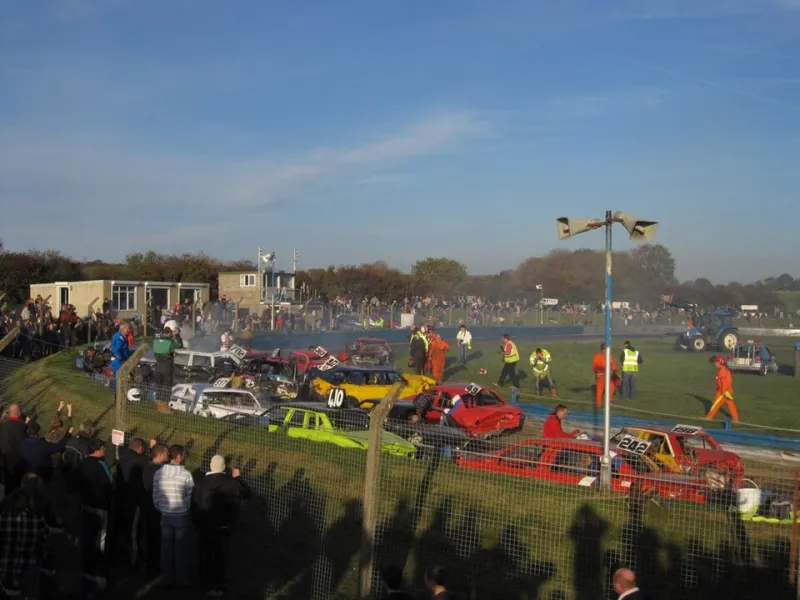
Photo: Dalags, CC BY 3.0, via Wikimedia Commons
There's a particular sound that greets you in the car park of a short oval on a Saturday night: a hammer on a bent door, a kettle clicking off, someone laughing at somebody else's mangled rear quarter. It is not the sound of a paddock full of motorhomes and data engineers. It is the sound of people fixing a car with a scaffold pole because the race starts in forty minutes.
Banger racing does not get much press. When it does, the tone sits somewhere between curiosity and a raised eyebrow — the assumption being that it's a bit of a laugh, a bit rough, and not really motorsport. That's a lazy read. Spend an evening trackside at a shale or tarmac oval — Foxhall Heath, Mildenhall, Northampton, one of the many small venues that keep the sport alive — and you'll see racing as honest as anything in Britain: close, hard, occasionally ridiculous, and run entirely by people who have spent their own money and their own weekends on a car that might not survive the night.
Fifty quid and a welder
The economics are the whole point. A banger begins life as a road car nobody wants — a tired hatchback, a scruffy saloon, something with a fortnight of MoT and a smell in the boot. It gets stripped, the glass comes out (mesh goes in), it gets caged, plated and given a fuel tank in a sensible place. The rulebook is longer than the stereotype suggests: roll cages, harnesses, seat mounts, fuel lines, cut-off switches and driver protection are all specified, and every car is inspected before it turns a wheel in anger.
But the spirit of it is shed-based. You build it with what you've got, you race it with what you've got, and when it comes back bent you straighten it with a ratchet strap and a tree.
Budget figures get thrown about, and the truth is you can spend as much as you like on anything with an engine. Even so, a competitive club-level banger remains one of the cheapest routes into wheel-to-wheel racing in Britain. Put it next to a season of circuit racing — licence, entry fees, tyres, fuel, a trailer, somewhere to keep the thing — and the gap isn't marginal. It's a different universe.
Contact is the format, not an accident
This is the bit that baffles people brought up on circuit racing, where a door-to-door rub earns you a trip to the clerk of the course. On the ovals, deliberate contact is written into the format. Spin him. Shove him. In the demolition derby at the end of the night, absolutely wreck him.
None of that makes it lawless. There are rules about hitting a driver's door, about following a stopped car in, about what happens when someone is stranded. The line is simply drawn in a different place, and everybody out there has signed up to it. That shared consent is what separates banger racing from a car park punch-up — and it's why the racing can be so close without the red mist turning into something genuinely dangerous.
The family firm
The other thing that strikes you is who's in the pits. Banger racing is a family sport in a way few branches of motorsport still are. Mum on the spanners. Dad on tyre pressures. A fourteen-year-old doing the fuel. A nan in a camping chair pretending not to watch the big one. The junior ladder exists too — Ministox has been bringing kids through from around ten years old for decades, and plenty of the adults in the big cars started there.
That pipeline matters. British motorsport spends enormous energy worrying about cost and accessibility. Banger racing quietly gets on with being accessible. No karting career, no sponsor deck, no father with a competition licence. You need a car, a helmet that passes inspection, a competition licence, club membership and a Saturday.
The sneer problem
So why the sniffiness? Partly class, let's be honest. Partly aesthetics — cars that look like they were assembled in the dark, drivers in boiler suits, a commentary box that sounds like it's broadcasting from a shed. And partly a genuine philosophical split: circuit racing prizes precision, banger racing prizes survival.
Then there's a moment, usually about ten laps into a final, when the field strings out and three cars go three-abreast into a bend, and the sneering stops. It's the same craft you see anywhere else: judgement, bravery, a racing brain reading a gap that's closing fast. Just with less carbon fibre and more gaffer tape.
Give it a go
If you've never been, pick a meeting and turn up. Tickets are cheap, kids usually get in for less, and the car park is full of people who will happily explain the difference between an unlimited banger and a two-litre. Stand near a bend rather than on the main straight — that's where the work happens.
And if you fancy driving rather than watching, the door is genuinely open. Buy a car, read the regulations properly, join a club, get it inspected, enter. You'll be slow. You'll be nervous. You'll probably get turned around in your first meeting. You'll also be racing, properly racing, for less than the deposit on a season of anything else.
British motorsport loves to talk about its grassroots. This is the grassroots — muddy, noisy, welded together in a driveway, and completely unbothered about whether you approve.